
1 active filter
1 active
Looking for reliable data center equipment in Bangladesh? ITbazar.net offers server racks, UPS systems, PDUs, network switches, servers, cooling accessories, and rack management products for businesses, ISPs, enterprises, and data centers. Build a secure, scalable, and power-protected IT infrastructure with trusted data center solutions designed for continuous operation and high-performance networking.
Showing 3 of 3 products
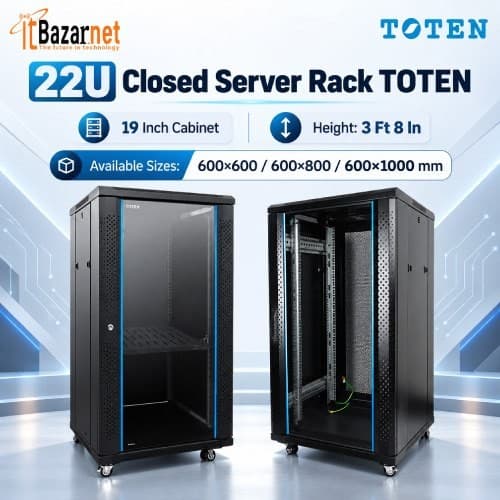

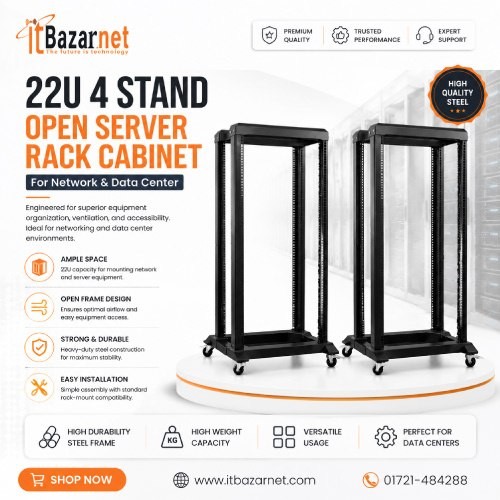
A data center is a dedicated facility or secured space where organizations store, process, manage, and distribute critical IT infrastructure. It typically houses servers, storage systems, networking switches, routers, firewalls, UPS systems, power distribution units, cooling equipment, and structured cabling. In Bangladesh, data centers are used by banks, telecom operators, ISPs, government organizations, universities, hospitals, factories, and large enterprises.
A modern data center is more than a room full of servers. It is a controlled environment designed to maintain uptime, protect hardware, manage heat, distribute power safely, and keep business-critical applications available around the clock. Whether it is a small server room or a large enterprise facility, proper planning is essential for reliability and scalability.
Businesses should invest in proper data center equipment because downtime can interrupt operations, damage productivity, affect customer trust, and create security risks. A well-designed data center keeps servers cool, power stable, network traffic organized, and critical systems protected from unexpected failures.
For small businesses, a compact wall-mount rack with a UPS and switch may be enough. For larger organizations, the setup may include multiple server racks, redundant power systems, managed switches, environmental monitoring, fire suppression, and dedicated cooling. The goal is always the same: maintain continuous access to applications, data, and communication services.
The exact requirements depend on the size of the operation, but most data centers include power protection, rack infrastructure, computing hardware, networking equipment, cooling, and cable management products. ITbazar.net provides server racks, open racks, wall-mount cabinets, PDUs, rack trays, UPS systems, and related infrastructure products.
Server racks, open racks, wall-mount cabinets, and closed racks house and organize IT equipment. They provide a standardized mounting structure for servers, switches, UPS units, patch panels, and PDUs.
Online UPS, offline UPS, mini DC UPS, and automatic transfer switches keep equipment running during power issues. In Bangladesh, where voltage fluctuations and outages can occur, UPS systems are among the most important data center investments.
PDUs, rack PDUs, and automatic transfer switches distribute and manage electricity inside racks. They help organize connections and, in advanced models, provide metering, circuit protection, and remote outlet control.
Rack servers, blade servers, tower servers, and storage servers run applications and store data. The right choice depends on workload, scalability requirements, available rack space, and budget.
Core switches, access switches, routers, firewalls, and SFP modules connect servers and manage traffic. Network capacity should match current demand while leaving room for future growth.
Rack fans, cooling trays, ventilation accessories, air-conditioning, and airflow management control heat and improve equipment reliability. Proper cooling prevents thermal throttling, shutdowns, and premature hardware failure.
Rack trays, cable managers, labeling tools, and patch panels keep cabling organized and serviceable. Structured cabling reduces troubleshooting time and lowers the risk of accidental disconnection.
A complete data center does not need every product on day one. Many organizations start with a rack, switch, UPS, and server, then expand as their workload and user base grow.
A server rack is a standardized cabinet or frame used to mount servers, switches, UPS units, patch panels, PDUs, and other data center hardware. Racks keep equipment organized, improve airflow, simplify cable management, and make maintenance easier.
Server racks are measured in “U” units, where 1U equals approximately 1.75 inches of vertical rack space. A 2U wall-mount rack provides limited space for compact equipment, while a 32U open rack offers much more capacity for servers and networking devices.
The right rack depends on available space, equipment quantity, security needs, airflow requirements, and whether the installation is in a dedicated server room or a shared office space.
Wall-mount racks are best for small offices, CCTV rooms, and compact IT spaces. They save floor space and provide a secure enclosed design, but their capacity is limited.
Open racks suit server rooms, network rooms, and ISP setups. They offer better airflow, easier access, and lower cost, though they provide less physical security.
Closed racks are suitable for enterprises and secure IT rooms. They provide better protection, an organized appearance, and controlled airflow, but usually cost more.
Floor-standing racks are used in medium and large data centers. They offer high capacity, scalability, and support for heavy equipment, but require more floor space.
A 19-inch rack is the standard format for most IT equipment. It is compatible with most servers and switches, but buyers must match equipment depth and weight capacity.
ITbazar.net offers wall-mount rack cabinets, open server racks, and closed rack options for different data center and networking environments.
An open rack provides easy access and excellent airflow, while a closed rack offers better physical protection, dust control, and a cleaner appearance.
Open racks are popular in ISP rooms, network operation centers, and internal server rooms where equipment is monitored and physical access is controlled. Closed racks are better for offices, shared spaces, and environments where equipment needs protection from dust, accidental contact, or unauthorized access.
A PDU (Power Distribution Unit) distributes electrical power from a UPS or wall outlet to multiple devices inside a server rack. It helps organize power connections and can include surge protection, circuit breakers, metering, and remote management in advanced models.
A basic PDU simply provides multiple power outlets. A metered PDU shows power consumption, while a switched or intelligent PDU allows administrators to monitor and control individual outlets remotely. For business-critical data centers, intelligent PDUs help prevent overloaded circuits and improve power visibility. IT Bazar offers basic and intelligent modular PDU options for rack-based power distribution.
A UPS (Uninterruptible Power Supply) provides temporary battery power during electricity fluctuations or outages. This gives servers, switches, storage systems, and network equipment time to shut down safely or continue running until backup power activates.
In Bangladesh, where voltage fluctuations and power interruptions can occur, a UPS is one of the most important data center investments. It protects not only against downtime but also against sudden power loss that can corrupt data or damage hardware.
An online UPS provides continuous power conversion and is generally preferred for servers, networking equipment, and critical business systems. An offline UPS is more affordable and suitable for less critical equipment.
An offline UPS switches to battery power during a power failure. It is suitable for desktops and basic office equipment and is usually the lowest-cost option.
A line-interactive UPS regulates voltage fluctuations. It is appropriate for small offices and moderate loads, offering a balance between price and protection.
An online UPS continuously converts and supplies clean power. It is the preferred choice for servers, data centers, medical systems, and other critical equipment, though it costs more.
A mini DC UPS provides DC backup for routers, ONUs, and cameras. It is a practical option for small network devices that require uninterrupted power.
For a serious server room or data center, an online UPS with sufficient capacity and runtime is usually the safest choice.
An Automatic Transfer Switch (ATS) automatically transfers power from a primary source to a backup source, such as a generator, when the main power supply fails. It is commonly used with generators and UPS systems in business-critical environments.
An ATS reduces manual intervention during power failures and helps maintain continuity for servers, networking equipment, and other critical loads. In a well-designed data center, the UPS covers the immediate power gap while the ATS transfers the load to backup generation.
A rack server is a server designed to mount inside a standard server rack. It saves floor space, simplifies cable management, and allows organizations to scale computing capacity by adding more servers over time.
Rack servers are available in different heights, such as 1U, 2U, and 4U. They are commonly used for web hosting, virtualization, databases, ERP systems, file storage, backup, and business applications.
A blade server is a compact server module that fits into a blade enclosure or chassis. Multiple blades share power, cooling, networking, and management resources, making blade systems suitable for high-density enterprise environments.
Blade servers are typically used by large corporations, data centers, and organizations running virtualization, private cloud, or high-performance computing workloads. They save space and simplify management at scale, but they require a larger upfront investment than standard rack servers.
A cloud server is a virtual server that runs on shared physical infrastructure and can be provisioned or scaled through software. Unlike a physical rack server, a cloud server does not require the user to own the underlying hardware.
Cloud servers are useful for businesses that want flexibility, remote access, and pay-as-you-grow scalability. However, many organizations still maintain on-premises servers or hybrid environments for data control, compliance, latency, or specialized workloads.
A switch connects servers, storage systems, firewalls, routers, and other devices within the data center network. It directs data traffic between connected devices and determines how efficiently applications communicate.
Data center switches are available in Gigabit, 10G, 25G, 40G, and 100G configurations. For small server rooms, a Gigabit switch may be enough. For virtualization, storage traffic, ISP backbones, and high-performance computing, 10G or higher-speed switches are often required.
A core switch is a high-capacity switch that acts as the central backbone of a network. It connects distribution switches, servers, routers, and other core infrastructure, handling large volumes of traffic with low latency.
Core switches are commonly used in enterprise campuses, ISP networks, data centers, and large office buildings. They often support high-speed uplinks, redundant power, advanced routing, VLANs, and traffic prioritization.
A 10G switch provides 10 Gigabit Ethernet connectivity through SFP+ ports or copper ports. It is suitable for server-to-switch connections, storage networks, virtualization hosts, and high-bandwidth backbone links.
For example, the ECOM 10G Switch ERS308-8S+ features eight 10G SFP+ ports, a Gigabit management port, dual-boot RouterOS/SwOS support, and fanless passive cooling. It can be used in a 1U rack or on a desktop, making it suitable for ISP and enterprise network deployments.
PoE (Power over Ethernet) delivers electrical power and data through the same Ethernet cable. PoE switches are commonly used to power IP cameras, wireless access points, VoIP phones, and other network devices without separate power adapters.
In a data center or office network, PoE switches simplify installation and reduce cable clutter. They are especially useful for surveillance systems, Wi-Fi deployments, and distributed office environments where powering devices at every location would be difficult.
Structured cabling is the organized system of cables, patch panels, racks, and labeling used to connect IT equipment. Proper cabling reduces downtime, simplifies troubleshooting, improves airflow, and makes future upgrades easier.
A poorly organized server room can quickly become difficult to maintain. Cable trays, patch panels, labels, color coding, and proper cable routing help technicians identify connections quickly and reduce the risk of accidental disconnection.
Servers, switches, UPS systems, and storage devices generate heat during operation. If heat is not controlled, equipment may throttle, shut down, or fail prematurely. Proper airflow and cooling protect hardware and maintain stable performance.
Cooling solutions include rack fans, ventilation panels, air-conditioning, hot-aisle/cold-aisle design, and environmental monitoring. Small server rooms may only need rack fans and proper ventilation, while larger data centers require precision cooling systems designed for continuous operation.
Redundancy means having backup components or systems that continue operating if a primary component fails. This can include duplicate power supplies, dual UPS systems, backup generators, redundant switches, and multiple internet links.
Redundancy is essential for businesses where downtime is costly. A single UPS may protect against short outages, but a complete redundancy plan may include online UPS, ATS, generator, dual power supplies, and separate network paths.
Prices vary greatly depending on rack size, UPS capacity, server configuration, switch speed, and enterprise features. Basic rack accessories are affordable, while enterprise servers and high-capacity switches can cost several lakh taka.
Rack accessories generally cost around ৳30–৳2,000. These include cage nuts, rack trays, cable managers, and small PDU-related components, making them essential for all data center users.
Wall-mount racks typically cost ৳2,900–৳15,000 or more. They are suitable for small offices, CCTV rooms, and compact networking installations.
Open server racks generally range from ৳14,000–৳50,000 or more. They are commonly chosen for server rooms and ISP environments.
Network switches range from about ৳720 to ৳32,000 or more, depending on port count, management features, and speed. They serve homes, offices, ISPs, and enterprises.
10G managed switches usually cost ৳13,000–৳50,000 or more. They are suitable for enterprises, ISPs, virtualization hosts, and high-bandwidth backbone connections.
Online UPS pricing varies by capacity, battery runtime, and brand. Server rooms and data centers should prioritize sufficient capacity and runtime over the lowest upfront price.
Rack servers generally start around ৳50,000 and can exceed ৳15,00,000 depending on processor, memory, storage, and scalability. They are used by SMEs, enterprises, and data centers.
Blade servers and high-end systems often start above ৳5,00,000. They are designed for large enterprises, virtualization platforms, private clouds, and high-density data center deployments.
Entry-level servers in Bangladesh often start around ৳50,000–৳80,000, while enterprise-grade data center servers can exceed ৳5,00,000 depending on configuration.
The best brand depends on whether you need servers, networking, power protection, or rack infrastructure.
Dell, HP, and Lenovo are widely used for servers, storage, workstations, and enterprise computing. They are common choices for businesses, corporate IT environments, SMEs, and data centers.
Cisco is known for enterprise switching, routing, and security, while Huawei offers cloud switches, enterprise networking, and telecom equipment. Both are suitable for large networks, carriers, and data centers.
MikroTik is popular for routing, switching, and ISP networking, while Ubiquiti is widely used for wireless, switching, and network management. These brands are especially relevant to ISPs, WISPs, and technical users.
Netgear and TP-Link provide switches and business networking products for offices and SMBs. They are practical options for smaller deployments and growing business networks.
BDCOM offers switches, OLT, ONU, and ISP equipment; VSOL focuses on PON, switching, and FTTH equipment; ECOM provides 10G switches and ISP networking products. These brands are commonly used by ISPs, network operators, and data centers.
A data center is a facility or secured space that houses servers, storage, networking equipment, power systems, and cooling infrastructure to support business applications and data services.
A server rack is a cabinet or frame used to mount servers, switches, UPS units, PDUs, and other IT equipment in an organized and serviceable way.
A rack server mounts directly into a standard rack, while a blade server fits into a shared chassis with other blades. Blade systems are more space-efficient but usually require a higher investment.
A UPS provides backup power during outages and voltage fluctuations, helping prevent downtime, data loss, and hardware damage.
A PDU is a Power Distribution Unit that distributes electricity to multiple devices inside a server rack. Advanced PDUs may include metering, switching, and remote management.
A 10G switch provides 10 Gigabit Ethernet connectivity, commonly through SFP+ ports. It is used for high-speed server, storage, virtualization, and backbone connections.
A core switch is a high-capacity central switch that connects major parts of a network, such as servers, routers, distribution switches, and data center segments.
Entry-level servers often start around ৳50,000–৳80,000, while enterprise-grade servers can cost above ৳5,00,000 depending on processor, memory, storage, and scalability.
An online UPS is generally the best choice for server rooms and data centers because it provides continuous, clean power for critical equipment.
ITbazar.net offers data center products including server racks, UPS systems, PDUs, network switches, servers, and rack accessories, with online ordering and nationwide delivery.

 PC Builder